

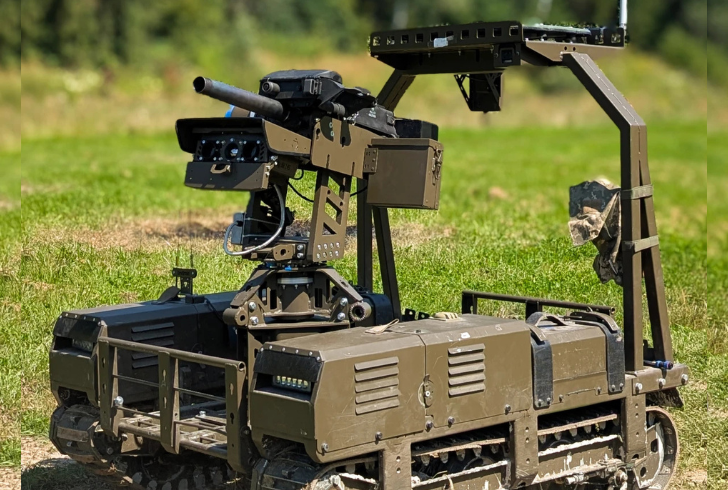
Ukraine’s military has officially approved a ground robot designed to operate two of the country’s most important grenade launchers, according to the manufacturer, DevDroid. This marks a significant step in the adoption of unmanned ground vehicles (UGVs) to strengthen the country’s defense while reducing direct risks to soldiers.
The newly approved robot, called Droid NW 40, is described by DevDroid as the first codified reconnaissance and strike UGV adapted for the US-made Mk-19 40mm grenade launcher and the Ukrainian-made AGL-53 automatic grenade launcher.
The Mk-19 has been a mainstay in NATO arsenals for decades, while the domestically produced AGL-53 gained military approval in Ukraine earlier this year. Both weapons are part of Ukraine’s effort to modernize and reduce reliance on Soviet-era armaments.
Role of Ground Robots in Ukraine
Unmanned ground vehicles are increasingly deployed to perform a range of combat and support tasks, including:
Firing at enemy positions and personnel
Destroying fortifications and obstacles
Evacuating wounded soldiers
These robots enable operators to remain at a safe distance while conducting complex combat missions. DevDroid highlights that the Droid NW 40 meets NATO standards and can engage personnel and lightly armored vehicles at distances up to 0.9 miles.
While ground robots have previously been used to fire grenades in Ukraine, this is the first time a design specifically adapted for these key launchers has received official military approval.
Adaptability and Innovation on the Frontlines
Oleksandr Yabchanka, head of robotic systems for Ukraine’s Da Vinci Wolves Battalion, has shared that some ground robots can be equipped with interchangeable turrets. These can attach an MK-19 grenade launcher, machine guns, or other weaponry, depending on the mission requirements. This modular approach allows units to customize robots much like building with Lego blocks, creating flexibility without needing multiple systems.
The rapid development of robotic systems in Ukraine is driven not only by manufacturers but also by soldiers, who provide real-time feedback from the battlefield. This collaboration accelerates upgrades and encourages practical innovation before formal defense ministry approval.
Current Usage and Capabilities
Ground robots remain a small fraction of Ukraine’s overall drone operations. Commander-in-Chief Oleksandr Syrskyi noted that in November, they accounted for less than 0.66% of total drone missions. The exact number of Droid NW 40 units to be produced or deployed is still unclear.
DevDroid emphasizes that its system allows complex missions to be executed from a safe distance, minimizing risks to personnel. Some units have reported continuous frontline operations using similar systems, such as the DevDroid TW 12.7, which operated with a .50-caliber machine gun for 45 consecutive days.
Innovation in Ukraine’s armed forces has centered on rapid adaptation. Dozens of companies are creating drones and robotic systems that let a smaller military conduct high-impact operations while conserving manpower.
Advancing Battlefield Robotics
The Droid NW 40 exemplifies the role of robotics in modern Ukrainian warfare. These systems enhance reconnaissance, support combat operations, and allow troops to operate with greater safety and efficiency.
By combining advanced robotic technology with U.S. and local weapons, Ukraine continues to innovate its forces, preserve tactical advantage, and explore the future of battlefield robotics.